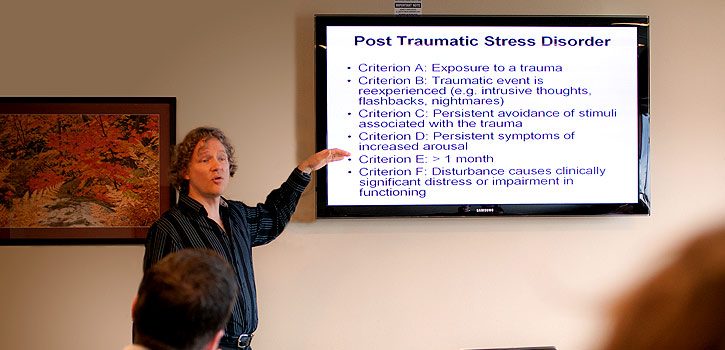
Every psychology resident participates in a required weekly didactic lecture-seminar series. This series is comprised of modules such as professional and ethical issues, diversity issues, diagnosis and assessment, supervision, consultation-liaison, empirically supported therapies, and psychopharmacology.
The content of didactics varies with the changing needs and interests of the residents and faculty. Subjects have included interviewing and diagnostic skills, community psychology, therapeutic methods, neuropsychology, treatment of populations with diverse cultural and personal values, and interprofessional relationships.
In addition, journal clubs in each track meet once a month: general adult psychology, general child psychology, behavioral medicine, and rehabilitation neuropsychology. Residents in the behavioral medicine and rehabilitation neuropsychology tracks will also participate in a weekly neuropsychology seminar.
The rehabilitation neuropsychology resident will also participate in bi-monthly fact-finding exercises. Psychology residents are expected to attend ten journal clubs during the course of the year; they can of course attend as many as interest them. The journal clubs meet at various times, as arranged by the coordinator of each journal club.
Psychology residents may attend one or more elective seminars such as: a seminar on Cognitive Processing Therapy (CPT) for Post Traumatic Stress Disorder or Prolonged Exposure Training for Trainees taught by Michele Bedard-Gilligan, PhD and Kristen Lindgren, PhD or Dialectical Behavior Therapy Workshop and Seminar taught by Kate Comtois, PhD.
Residents may also join the psychiatry residents in seminars on Interpersonal Psychotherapy or Cognitive-Behavioral Therapy taught by various members of the regular and clinical faculty on a rotating basis.
Residents are encouraged to attend lectures in the University of Washington community, including the Department of Psychiatry and Behavioral Sciences Grand Rounds (Department of Psychiatry and Behavioral Sciences).
Program Lectures and Seminars
-
- Didactics
Thursdays 3:00 p.m. – 5:00 p.m.
2026-2027-DidacticsSchedule – Hybrid locations / zoom PDF - Grant Writing and Career Development Seminar
Thursdays 1:00 p.m. – 2:00 p.m.
Program Statement
Grant Writing and Career Development Seminar Schedule 2021-2022 - Stewardship
3rd Thursday Stewardship Group each month: 10/20, 11/17, 12/15, 1/19 - Journal Clubs
Due to the nature of Journal Club, presenters and topics aren’t typically known far in advance.- Adult – General Track 2023-2024
Last Tuesday of the month from 4:00 p.m. – 5:00 p.m.
Coordinator: Dr. Katherine Walukevich-Dienst kwd1@uw.edu - Behavioral Medicine / Rehabilitation Neuropsychology Tracks 2023-2024
Last Wednesday of the month at 12:00 p.m. – 1:00 p.m.
Coordinators: Dr. Jeff Sherman jeffreys@uw.edu and Victoria Vassall vassal@uw.edu - Child General and Autism and Developmental Disabilities Tracks 2023-2024
First Wednesday of the month at 12:00 p.m. – 12:50 p.m.
Coordinator: Kari WIlliams kari.williams@seattlechildrens.org - Autism and Developmental Disabilities Track 2023-2024
Generally first Thursday of the month at 2:30 p.m. – 3:00 p.m.
Through the UW Autism Center. Timing can vary.
Coordinator: Fritz Reitz, PhD freitz@uw.edu
- Adult – General Track 2023-2024
- Didactics
- Diversity Advancement Committee
The DAC meets once a month on the last Thursday starting July 27th from 1:00 p.m. – 2:00 p.m. via Zoom. - Grand Rounds
Psychiatry and Behavioral Sciences Grand Rounds
Other Events and Learning Opportunities
- Annual UW CAMS Training – Cancelled due to COVID, not sure of next start date
- Annual CPT Training – 9/13 and 9/18 (9:00 a.m. – 4:30 p.m.) – Registration opens July 8th, email link will be sent
- DBT Training Options 2026There are three different training options for psychology residents to choose from:
Tier 1: 2-Day DBT Overview Workshop
This virtual workshop is a two-day introduction to DBT. It is required to participate in Tiers 2 & 3.- Day 1 focuses on the theory and structure of DBT and provides an overview of treatment strategies.
Presenter: Dr. Kate Comtois - Day 2 focuses on behavioral analysis, commitment, and crisis strategies with an emphasis on effective initial sessions with a DBT client.
Presenter: Dr. Adam Carmel
Tier 2: Seminar Series
The Seminar Series consists of 21 weekly sessions covering all the theoretical underpinning and major strategies of DBT, as well as applications with adolescents. It involves weekly reading, homework, and a self-graded final exam.It is taught by a range of Seattle area supervising DBT clinicians.Tier 3: Clinical Training
Provides supervised individual and group therapy clinical experience with DBT.Please check out the DBT training website to find the syllabus and all details about the components of training:
https://uwcspar.org/education-and-training/upcoming-trainings/annual-dbt-training/
- Day 1 focuses on the theory and structure of DBT and provides an overview of treatment strategies.
- Wilbert E. Fordyce Lecture
- February 26, 2026 – Dawn Ehde, PhD, University of Washington, Department of Rehabilitation Medicine – Rethinking Relief: Advancing Pain and Fatigue Care in Multiple Sclerosis
- April 4, 2024 – Michael Nicholas, PhD, University of Sydney, Australia – Interdisciplinary Pain Management in 2024: Personalized health care or a muddle?
- January 27, 2020 – Lynn DeBar, PhD, MPH – Sustainable, Patient-Centered, Evidence-Supported, and Behaviorally-Focused Chronic Pain Management in Primary Care: What Will it Take to Move the Dial?
- January 22, 2019 – Tonya M. Palermo, PhD – Psychological Interventions for Children and Adolescents with Chronic Pain: Maximizing Treatment Effects and Reach
- January 6, 2018 – Michael John L. Sullivan, PhD – Psychological Risk Factors for Delayed Recovery
Following Musculoskeletal Injury - January 10, 2017 – Mark P. Jensen, PhD – A Legacy of Clinical Mastery
- February 26, 2016 – Lorimer Moseley, PhD – The Brain in Pain: from clinical observations to new treatments
- January 7, 2015 – Francis J. Keefe, PhD – Coping with Chronic Pain: What We Know and What We Need to Learn